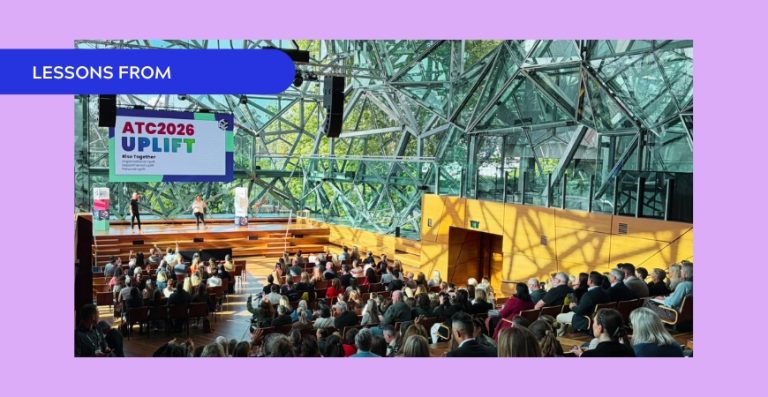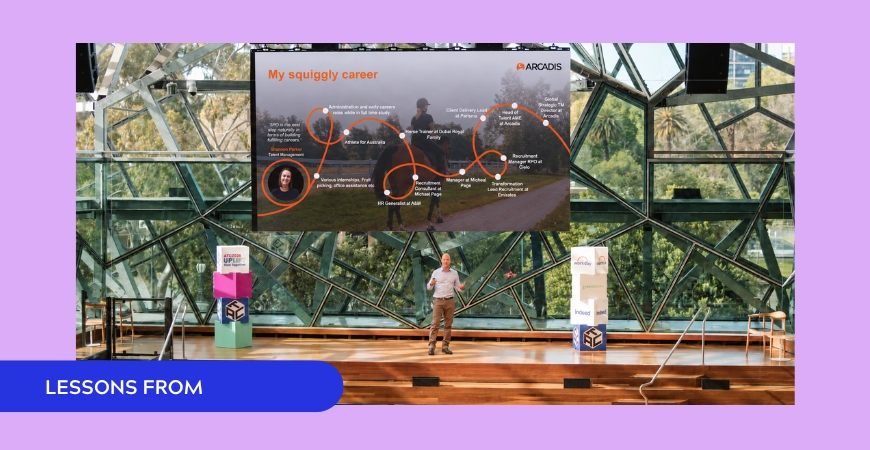
At ATC2026, Hugh Ragg shared an honest reflection on Arcadis’ four-year journey towards becoming a skills-powered organisation, including the successes, challenges and unexpected turns along the way.
With approximately 35,000 employees globally, operating across more than 20 countries, Arcadis set out to change how it identifies, develops and deploys talent. The ambition was to move beyond traditional job titles and career pathways, giving employees greater visibility of their skills while helping the business make better workforce decisions.
Four years on, the results are compelling. Time to fill reduced by 15 days, voluntary platform adoption exceeded 80%, and internal project opportunities generated more than 10,000 billable hours.
But perhaps the most valuable part of Hugh’s presentation wasn’t the results. It was his openness about what didn’t go to plan, and what it really takes to embed skills into an organisation.
Here are eight lessons from Arcadis’ transformation journey.
💡 Lesson 1: Get your foundations right before you start building.
When Arcadis began its transformation in 2022, the business discovered that its existing job architecture wasn’t quite ready for a skills-based approach.
Across 35,000 employees, there were approximately 7,000 unique jobs. Before skills could be effectively mapped to roles, that number needed to be reduced. Today, Arcadis has around 2,000.
The organisation also needed a common language for skills and proficiency levels across more than 20 countries.
Using Eightfold as its technology partner, Arcadis built its skills taxonomy and connected the platform with its existing systems.
💡 Lesson 2: Discover the skills you already have.
One of the early challenges was communicating the value of a skills-powered organisation to employees.
Initially, Arcadis introduced the concept of ‘squiggly careers’, encouraging people to consider career paths that weren’t necessarily linear.
It didn’t resonate particularly well with its engineering workforce, where more structured career progression was often expected. So, the team changed its approach.
Instead of explaining the philosophy, they demonstrated the experience. Employees could identify their skills, discover potential career pathways, explore opportunities they hadn’t previously considered and access personalised learning recommendations. Managers gained visibility of capabilities and career interests they might otherwise never have discovered.
Hugh shared a particularly memorable example of a global director searching for someone with experience working in Antarctica. After months of looking, the right person turned out to be sitting directly behind him. The capability was already there. The visibility wasn’t.
Sometimes the biggest talent opportunity isn’t finding someone new. It’s discovering the skills you already have.
💡 Lesson 3: Connect your skills strategy to measurable business value.
Arcadis had several ambitions for its transformation, including reducing attrition, improving employee experiences, closing skills gaps and supporting more informed workforce decisions. However, Hugh acknowledged that some of these outcomes were difficult to attribute directly to the skills initiative.
Voluntary attrition, for example, is influenced by numerous organisational factors. Proving that a skills platform alone improved retention would be challenging. Other outcomes were far more tangible. For example, by mapping skills to jobs and employees, Arcadis reduced time to fill by 15 days over two years.
For an organisation hiring approximately 6,000 people annually, that’s a significant operational improvement. The business also began identifying opportunities to deploy existing employees on work that might otherwise be outsourced.
💡 Lesson 4: Plan for the long-term, but expect a non-linear journey.
Arcadis initially structured its transformation around three horizons, beginning with skills foundations, career pathways and personalised learning before progressing into internal projects, workforce planning and more sophisticated skills applications. On paper, the roadmap was logical and linear. In practice, it was anything but.
The organisation experienced leadership changes, shifting priorities, a global restructure and changes in executive sponsorship. Some initiatives moved faster than expected, while others had to be delayed because the business wasn’t ready. Hugh reflected that the transformation itself became rather like the ‘squiggly careers’ concept the team had initially tried to introduce.
💡 Lesson 5: Executive sponsorship gets you started. Leadership ownership keeps you going.
Arcadis benefited from strong executive support early in the journey. Its CEO had incorporated the skills-powered ambition into the organisation’s three-year strategy, creating momentum from the top.
More than 100 change champions supported the global rollout, helping with briefing sessions, gathering feedback and encouraging adoption. Following a pilot involving approximately 2,000 employees, the platform launched globally in March 2024.
Initial engagement was strong, with voluntary adoption exceeding 80% and a user experience score of 3.7 out of five after approximately six months.
However, when leadership changed and the organisation restructured, momentum became harder to maintain. The launch of internal project opportunities, known as ‘gigs’, highlighted the importance of support beyond the executive team. Some leaders questioned the initiative until they began seeing tangible results. Hugh emphasised that People teams cannot be the sole custodians of these programs.
💡 Lesson 6: Stop thinking only about jobs. Start thinking about work.
One of the more interesting developments in Arcadis’ journey was the introduction of internal gigs. Rather than limiting employees to the responsibilities of their existing job descriptions, the platform matches people to projects based on their skills.
An employee might contribute 20 hours over three weeks to a project outside their usual team or service line. This created opportunities for people to apply and develop their capabilities across the organisation, including working in service lines they hadn’t previously been exposed to.
Despite a challenging launch, Arcadis reached 100 internal gigs and more than 10,000 billable hours. Hugh explained that Arcadis spends approximately $1 billion annually on materials, service providers and contractors. Identifying skills already available internally could help the business retain more work and reduce external expenditure.
It also opens up a broader conversation about workforce utilisation. If an employee is working at 70% capacity, could their skills be applied elsewhere to increase that utilisation?
💡 Lesson 7: Skills visibility is only the beginning. Proficiency is where the value grows.
Knowing that someone has a particular skill is useful. Understanding how proficient they are is far more valuable. Arcadis’ approach allows employees to self-assess their skills, with managers and subject matter experts also contributing assessments. This creates a more meaningful picture of organisational capability and helps identify genuine development gaps.
The organisation has also integrated skills discussions into its performance cycle, connecting development plans with learning, mentoring and practical work opportunities. Rather than treating skills data as a one-off exercise, employees and managers revisit it through regular conversations. This is particularly relevant as AI changes the skills required across different roles. Instead of assuming an entire job will become redundant, organisations can examine the individual tasks involved, identify where AI can assist and determine which capabilities employees should develop next.
💡 Lesson 8: Embed skills into everyday business decisions.
One of the strongest themes throughout Hugh’s presentation was the importance of making skills part of how the organisation actually operates.
At Arcadis, skills have been integrated into onboarding, career progression planning, performance conversations and client bids through its Oracle ERP environment. The client-bid integration gives Arcadis visibility of the skills clients are requesting, helping the organisation understand emerging demand and identify internal capabilities that can deliver the work.
Looking ahead, the organisation is also exploring more targeted mandatory training, where employees can demonstrate existing proficiency rather than completing training on capabilities they already possess. Across a workforce of 35,000 people, even relatively small efficiencies can represent substantial time savings.
The broader ambition is to continue moving towards a work architecture that considers jobs, projects, tasks, skills and individual interests together.
💡 Lesson 9: Keep your skills framework connected to how work is changing.
A skills framework needs to evolve as the capabilities required by the business change. Asked how Arcadis approaches emerging or obsolete skills, Hugh explained that their technology provider Eightfold, gives them access to an aggregated skills database, alongside the ability to add and personalise skills for the organisation.
By mapping skills to jobs, Arcadis can see which skills are becoming more relevant and which are becoming redundant. But Hugh emphasised that mapping skills to approximately 2,000 jobs, in collaboration with line managers, was no small task. The technology supports the process; building a useful organisational dataset still takes work. He also stressed that the focus should be on skills proficiency. Knowing which skills are changing in relevance, and how proficient people need to be, gives the organisation a clearer basis for deciding what to develop next.
What stood out from Hugh’s presentation was the balance between ambition and pragmatism. Arcadis didn’t have perfect data, a perfectly aligned job architecture or an uninterrupted transformation journey. Leadership changed, priorities shifted and some initiatives encountered resistance. Yet the organisation continued to build, adapt and demonstrate value.
For Talent and People leaders, there’s an important distinction here: becoming skills-powered isn’t simply about implementing a technology platform or building a comprehensive skills taxonomy. It’s about changing how an organisation understands its people, develops capability and allocates work.
More content on Arcadis and Eightfold
https://eightfold.ai/learn/building-a-skills-powered-workforce-at-arcadis/
https://eightfold.ai/customers/customer-stories/arcadis-makes-the-shift-to-skills-based-work