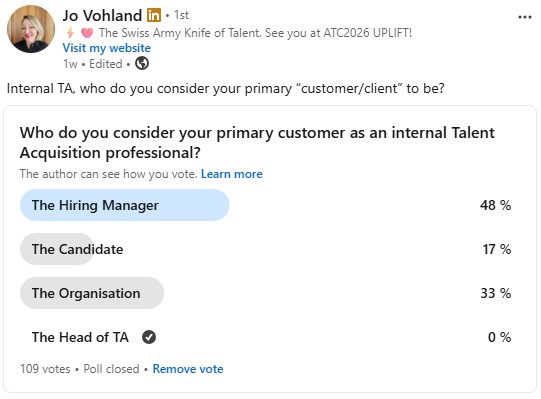
Our recent LinkedIn poll surfaced an important mindset shift for Internal Talent Acquisition Teams.
When asked who they saw as their ‘Customer’, the largest proportion of respondents (all Talent Acquisition Leaders and Senior Recruiters) chose ‘The Hiring Manager’. That perspective reflects a traditional recruitment model, where success is defined by responding well to a hiring request. It’s also not usual for many to have this view given the Service Level Agreements in place that inspire a client/supplier style relationship. However, Talent Advisory opens the door to a more influential role. In this instance, the Organisation becomes the customer, making the hiring manager a strategic partner who co-owns the hiring responsibility.
The focus expands from filling a vacancy to understanding the business priority, defining the capability required and determining the best way to access it.
This is where Talent Acquisition can create greater value to the Organisation and where Talent Advisors may future-proof their careers from automation and outsourcing.
The following comparison shows how a Traditional Recruiter responds versus a Talent Advisor, making the mindset shift needed very clear.
| Element | Traditional Recruiter | Modern Talent Advisor |
| Primary Customer
|
The Hiring Manager | The Organisation. The Hiring Manager is my Partner and co-owns the hiring responsibility.
|
| Response to a requisition | Accepts the requisition as the solution. | Treats the requisition as one possible solution that should be tested. |
| Thinking evolves from… | Role → Candidate → Hire | Business Outcome → Work → Capabilities Needed → Build, Buy, Borrow, Bot |
| Range of Solutions | Defaults to external recruitment. | Evaluates Build, Buy, Borrow, Bot, Scarcity/Criticality Matrix, Internal Mobility, Contingent Capability and Blended Workforce Solutions |
| Trigger point | Engages once an external hiring requisition has been approved. | Engages when a capability gap, workforce risk or business opportunity is identified. Often one of the following:
1. WFP identifies future capability needs, or succession risks that require external talent intelligence, market mapping or talent pipelining. 2. An internal mobility, redeployment or succession opportunity is identified that could fulfil a workforce requirement. 3. An external hiring requisition is approved. |
| Business relationship | Receives the request and provides progress updates. | Partners with the business, brings evidence, influences decisions and constructively challenges assumptions. |
| Handling unrealistic expectations | Continues searching and hopes the market delivers. | Quantifies constraints and helps the business redesign expectations or explore alternative workforce solutions. |
| Prioritisation | Responds to urgency or the loudest stakeholder. | Prioritises according to business criticality, capability risk and organisational value. |
| Sources of evidence | Uses the ATS, applicant pools and previous recruitment activity. | Integrates internal capability, workforce planning, labour market intelligence, commercial considerations, technology roadmaps and AI opportunities. |
| Market expertise | Reports shortages and salary expectations. | Explains market dynamics, talent availability, competitor activity, remuneration trends and commercial trade-offs. |
| Response to delay | Chases feedback and sends reminders. | Diagnoses organisational bottlenecks, quantifies their impact and works with stakeholders to improve decision-making. |
| Accountability after hire | Considers the work complete once the person starts. | Reviews whether the workforce decision delivered the intended business outcome and continuously improves future workforce decisions. |
| Value story | We filled 40 roles and reduced time-to-hire. | We helped the organisation solve a business problem, strengthen capability and make better workforce decisions.
|
Why not the Candidate as the Customer?
One of the more understandable results was the number of people who selected the Candidate as the Customer. Whilst great Recruiters aim to provide a customer-like level or care and attention to candidates, in hiring, the majority are ultimately not selected and therefore never receive the end product (work). They are actively removed at various steps in the hiring journey – not something you do to your customers. Candidates are, in our view, essential and important participants in the process who deserve an exceptional experience, but the organisation is the customer because the purpose of recruitment is to deliver the workforce outcomes the organisation needs.
I asked some of the Talent Leaders who selected “The Organisation” as their answer to share why they take this approach.
Martha Creedon, Talent Attraction & Mobility Manager, Australia Post
“Prioritising the organisation helps Talent Acquisition act as a strategic adviser rather than a transactional service provider. By focusing on enterprise priorities, workforce planning and future capability needs, we can balance competing demands, allocate talent effectively and ensure every hiring decision contributes to broader organisational success and sustainability. In my view, the future of TA is skill/capability based hiring with more fluidity on roles and responsibilities to maximise productivity, agility and employee engagement.”
Emily Alexander, P&C (Finance & AU) & Talent Lead, Phocas Software
“I chose the organisation as my customer, as every hire has to move the business forward. We hire against outcomes, with a focus on talent density. Hiring is accountable to performance and growth, and that’s also why people want to work here: they’re challenged in their work, they grow, and they genuinely enjoy that.”
Katrina Collier, Author of The Robot-Proof Recruiter and Reboot Hiring
“Hiring Managers are TA’s colleagues not clients. If considered a customer, TA enters the process with a subservient mindset instead of thinking about creating a healthy, balanced and successful partnership.”
Ben Elson, Talent Acquisition Leader, EMEA & South Asia
“The primary customer always has to be the Org. Too many times you’ll see HM’s pulling in a different direction, purely aligning their needs for the immediate. At times this isn’t aligned to the “bigger picture” or longer term strategy.”
Laura White, General Manager, People, Akaysha Energy
“My view is that the true customer of talent acquisition is the organisation, and TA represents that customer throughout the process, weighing every hire through a whole-of-business lens, from capability gaps and future skills needs to internal mobility and financial discipline. When a TA professional brings that context from the outset, they partner with the hiring manager to service their needs, give the candidate a true and accurate picture so their decision to join is fully informed, and land on an outcome that serves the business over the long term, not just a short-term fill. That’s the shift from being an effective recruiter to a strategic talent partner, one who stands as the organisation’s own representative in every hiring decision.”
Julie Morgan, Contingent Workforce Leader, Water Corporation
“The organisation is TA’s key customer because our mandate extends beyond individual hires. We are responsible for building workforce capability, reducing talent risk and enabling business performance. While delivering a great experience for hiring managers and candidates remains essential, our success is ultimately measured by the value we create for the organisation.”
How Talent Advisors behave differently
I asked our friends at TCS Insights, Australia’s leading Talent Advisory firm what core capabilities are needed in a Talent Advisor.
Trevor Vas says, “The transition from Transactional Recruiter to Talent Advisor requires more than new processes. It requires different ways of thinking and behaving.”
TCS Insights has identified six behavioural capabilities that consistently distinguish high-performing Talent Advisors.
| Element | Traditional Recruiter | Modern Talent Advisor |
| Curiosity | Accepts the brief largely at face value. | Explores whether the brief reflects the real business need before recommending a solution. |
| Insightfulness | Reports market information. | Synthesises business strategy, workforce data, labour market intelligence and commercial insight into practical recommendations. |
| Creativity | Searches harder for candidates. | Designs alternative workforce solutions by combining Build, Buy, Borrow and Bot. |
| Comfort with Ambiguity | Prefers certainty before acting. | Is comfortable evaluating competing workforce options where no single answer is obvious. |
| Agility | Responds to today’s hiring requirements. | Continuously adapts recommendations as business priorities, technology and labour markets evolve. |
| Humility | Provides recruitment answers. | Uses thoughtful questions to help the business reach better workforce decisions. |
How to assess where you and your team are on the Talent Advisory Continuum.
TCS Insights has a range of free assessments you can take. I suggest that you start with these two:
- Where Does Your Organisation Sit? Thinking about how your Talent function currently operates, this short Pulse-Check explores how your team performs across key Talent Advisory areas including Collaboration, Insightfulness, Analytics, Influencing and Creativity.
- Who Are You as a Talent Advisor? Every advisor has a natural style. This individual assessment uses scenario-based ranking to uncover yours.
Take the free Assessments here.