I am old enough to remember recruiting before any ATS systems or computers. We had file cabinets, folders, and Rolodexes for contact information.
I think it was around 1990 when Resumix, one of the first ATSs, appeared. Its resume-parsing/extraction technology promised to make it easy to search resumes and connect with candidates. It was revolutionary and exciting. We felt like we were on the cusp of an easier, more automated life. It didn’t prove to be either easier or more automated. It actually created more work. Not much different in a way than some recruiters now feel about AI.
But applicant tracking systems have evolved to become the most entrenched technology in recruiting. They have grown beyond our wildest expectations into the system of record, the compliance archive, the workflow engine, the reporting tool, and, in many organizations, the closest thing recruiting has to an operating system. For most recruiters and HR executives, imagining recruiting without an ATS is almost impossible.
The ATS exists because recruiting was built around applications. A job is approved. A requisition is opened. A job is posted. Candidates apply—recruiters screen. Hiring managers interview. Offers are made. Compliance records are stored. Reports are generated.
The entire architecture assumes that hiring begins with a requisition and that candidates enter the process by applying.
But AI challenges these assumptions.
Will the ATS remain the center of recruiting once AI agents can identify talent, infer skills, verify credentials, conduct preliminary assessments, schedule interviews, generate summaries, recommend finalists, and maintain auditable decision trails?
I doubt the ATS will vanish, but it will morph to become infrastructure. It will become like plumbing as an almost invisible foundation.
Why the ATS Became Core
The ATS became critical because it solved several problems. It brought order to a messy, paper-based, and eventually email-driven process. It created a common workflow. It stored candidate information. It provided requisition control. It gave recruiters a place to track activity and legal, compliance, and audit teams a record of what happened.
The ATS is not only a recruiting tool. It preserves records, documents candidate disposition, supports equal employment opportunity reporting, and creates evidence that the organization followed a defined process.
This is why the ATS has survived despite decades of complaints. Recruiters dislike most ATSs. Candidates dislike them even more. Hiring managers don’t know they exist or ignore them. Yet companies keep them because they provide structure, control, and compliance.
AI Does Not Need the Same Workflow
With AI, we no longer need the old sequential model that has defined recruiting for so long.
Today’s model looks like this:
Requisition → Posting → Application → Screening → Interview → Offer → Hire
But an AI-enabled model looks more like this:
Business need → Work analysis → Talent discovery → Skills inference → Assessment → Matching → Decision support → Hire
This is a major change, and we are just beginning to understand what it means.
The current ATS is built around requisitions and applicants. AI is built around talent, skills, work, availability, and fit. The ATS asks, “Who applied?” AI asks, “Who could do this work?”
Those are very different questions.
If the future of recruiting is still based on job postings and applications, the ATS remains central. If the future shifts toward continuous talent discovery, internal mobility, skills-based matching, verified credentials, and agentic sourcing, the ATS becomes a record layer beneath a broader talent operating system.
The Application May Be the Weakest Link
Let’s ask this question.
What happens when nobody needs to apply?
Applying is slow, inefficient, and open to fraud and misrepresentation. It requires candidates to find the job, interpret the posting, enter repetitive information, and hope for a match. This process once made sense when organizations had no scalable way to discover, assess, and engage people directly.
But that constraint is weakening with AI.
AI agents can search internal databases, external talent pools, professional networks, alumni communities, contractor platforms, learning records, credential repositories, and prior candidate histories. They can infer adjacent skills, detect likely availability, personalize outreach, and rank potential matches. Rather than candidates looking for a suitable role, AI can find and match them with one.
If that becomes reliable (and it will), applying then becomes unnecessary. Candidates still need to consent. They still need to verify interest and provide information. But they will not begin the process by filling out a traditional application.
Compliance Will Slow the Change, Not Stop It.
However, rather than removing the need for record-keeping or tracking, AI increases the need. We will still need to document decisions and track evaluation criteria. We will have to maintain audit trails and support reporting.
This is why the ATS will not disappear.
But this does not mean that the ATS must remain the primary user interface or the core operating model.
Compliance systems often move into the background. Recruiters may interact with an AI agent, a talent intelligence platform, or a workforce planning system while the underlying compliance record is written automatically
The ATS evolves into several layers.
First, there will be a talent graph: a dynamic representation of people, skills, credentials, experience, interests, availability, compensation expectations, mobility, and performance signals.
Second, there will be a work graph: a model of jobs, tasks, projects, capabilities, outcomes, and changing business demand.
Third, there will be an AI orchestration layer: agents that match work to talent, recommend sourcing strategies, generate outreach, coordinate assessments, and support decision-making.
Fourth, there will be a compliance and audit layer: the successor to the ATS as a system of record.
The ATS is strongest in the fourth layer.
These changes will develop over time. Here is my rough time frame for the major changes.
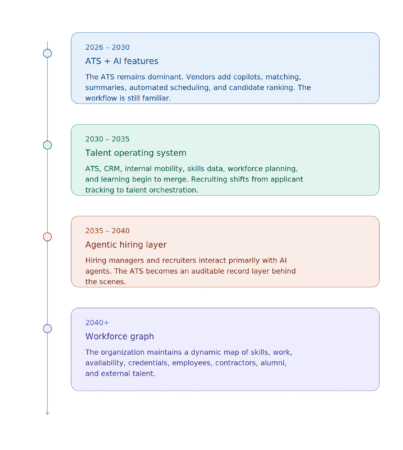
The dates are not precise predictions but are general indications of direction. Large regulated enterprises will move slowly. High-volume hiring functions may move faster. Technology companies and professional services firms may experiment earlier. Government, healthcare, and financial services will be more cautious.
But the direction is clear. The ATS does not disappear in one dramatic event. It is gradually surrounded, abstracted, and absorbed.
What Recruiters Should Understand
Recruiters should understand that administrative tracking will matter less. Talent intelligence will matter more.
Posting jobs will matter less. Understanding work will matter more.
Processing applicants will matter less. Advising on talent options will matter more.
Owning requisitions will matter less. Orchestrating internal, external, contingent, and automated work will matter more.
The recruiter of the future will not be measured primarily by how efficiently they move applicants through stages. They will be measured by how well they help the organization decide what work needs to be done, what capabilities are required, where those capabilities can be found, and whether hiring is even the best answer.