Download the 2025 State of TA Report

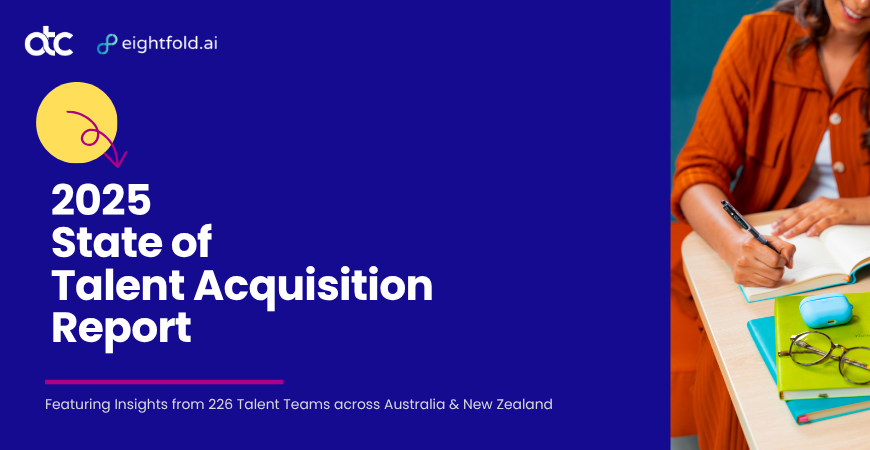
In March 2025, 226 Talent Teams from across Australia and New Zealand gave us a picture of what is happening inside their Talent function right now.

Participants were asked about a range of factors related to TA, including how well they deliver talent, their current level of involvement in Talent Advisory, the state of their Internal Mobility, the Gender Pay Gap, their relationships with other parts of the business, their attitudes towards AI, Candidate Experience and Candidate Fraud, and so much more.

These results give us a clear insight into current recruitment trends, how talent teams are feeling, and what the talent priorities are right now.

Delivered in partnership with our friends at Eightfold, the 2025 State of Talent Acquisition Report is a resource for Talent Teams to get a better idea of where Talent Acquisition is headed and provide benchmark data against which to review their own function.

Watch the 2025 State of TA report delivered by ATC Events & Media

Download the 2025 State of Talent Acquisition Report


Article By

Get more articles direct to your inbox

Upcoming Events

Annual Conference: ATC2026 UPLIFT

13 & 14 October 2026

AI Uplift Workshop: Play Ball with AI

September and October 2026

Download the 2026 State of Talent Acquisition Report

You may also enjoy reading...

The shift to becoming a Skills-Based Organisation sounds straightforward: understand the skills you have, identify the capabilities you need, and use that insight to make better workforce decisions. In practice, getting there requires changes to how organisations think about jobs, workforce planning, learning, technology and, importantly, the role of Talent Acquisition. For TA Teams, this creates an opportunity to move beyond replacing roles like-for-like and play a more active role in shaping the capabilities the organisation needs next. But what does that actually look like in practice?
Our recent LinkedIn poll surfaced an important mindset shift for Internal Talent Acquisition Teams. When asked who they saw as their ‘Customer’, the largest proportion of respondent (all Talent Acquisition Leaders and Senior Recruiters) chose ‘The Hiring Manager’. That perspective reflects a traditional recruitment model, where success is defined by responding well to a hiring request.
As organisations rethink how work gets done, the boundaries between Human Resources, Talent Acquisition, Learning and Development, and the emerging discipline of Talent Architecture and Orchestration are becoming less clear. This operating model provides a practical comparison of each function’s purpose, trigger point, responsibilities, risks and measures of success.