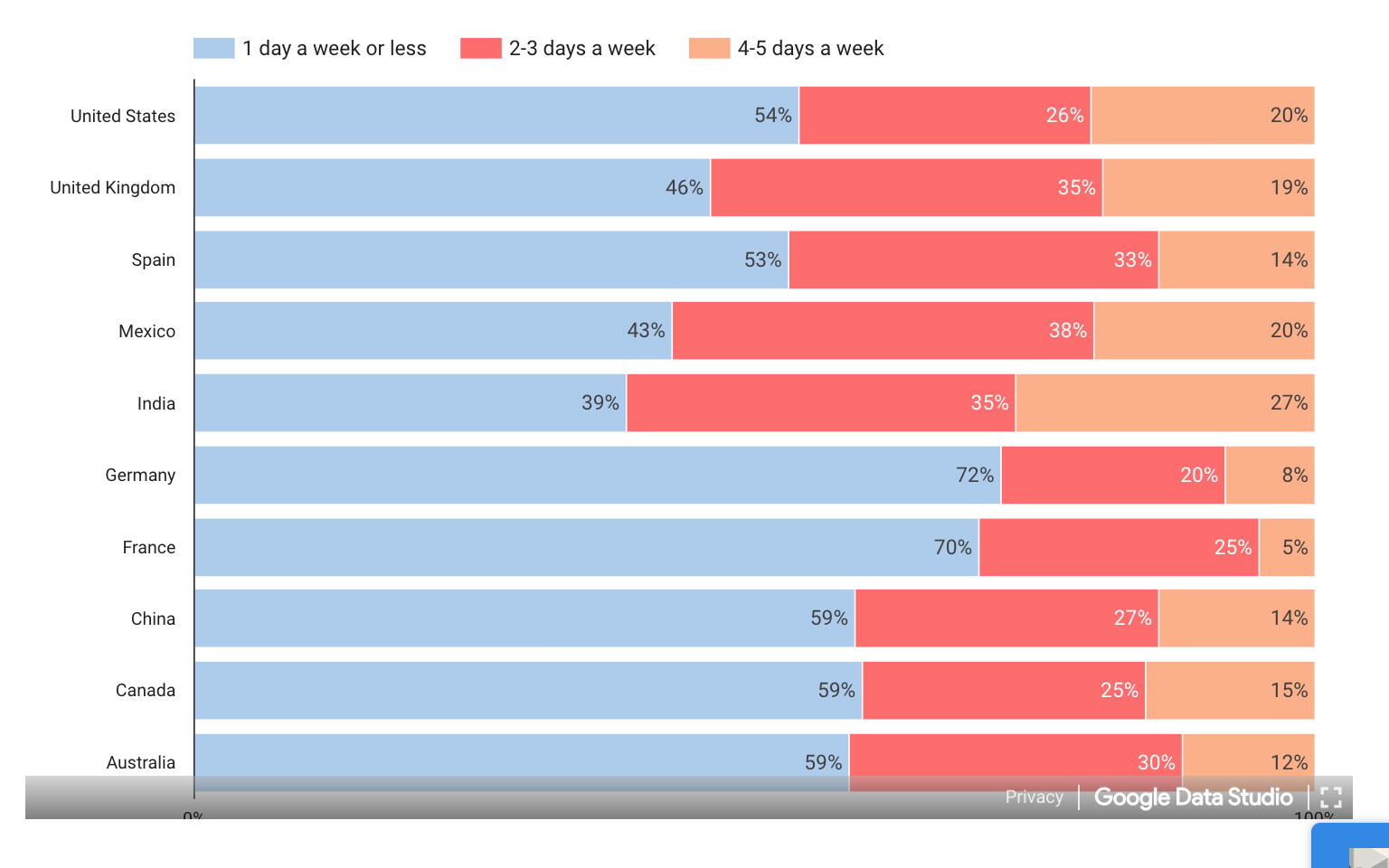
In the U.S., about 65% of workers are working remotely from home, according to a report from YourBestDigs. This is unprecedented and yet has become normal for millions of people. And, according to a report from Steelcase (Figure 1), most employees never want to go back to the office full-time.
But old thinking prevails. Google, Microsoft, Apple, and hundreds of other companies have tried to encourage workers to return. Many firms have demanded that workers return or lose their jobs. Employees at Google, Twitter, and Facebook are upset over the announcements that pay may be reduced if they live in less expensive areas. Reducing pay may be a bad idea as employees will look for employers who will not cut their pay. Reducing pay may also have an adverse impact on women who make up a large portion of remote workers and who are already, in many cases, underpaid compared to a male counterpart. In response to the backlash as well as because of the ongoing pandemic, Microsoft recently gave up predicting when, if ever, workers would return full-time to work.
Just as companies struggle with the idea of virtual workers, recruiters struggle with virtual recruiting.
Many recruiters do not like the idea of never seeing a person face to face. They believe in-person communication helps them assess body language, dress, and other subtle (and often very biased) factors. And they worry, with reason, that their jobs may be in peril with the rise of automation and user-friendly software.
But virtual recruiting and work are not only possible but already growing. Almost all recruiting has been virtual for months and this makes automating processes more likely to accelerate. Recruitment automation is a given. It may not in the short-term cause massive reductions in recruiter employment, but over the long term, it will.
The Modern Scenario
We have recruited virtually for almost two years now, albeit mostly with recruiters still heavily involved personally using Zoom or Microsoft Teams or the telephone. Recruiters are still trapped in yesterday’s mindset and not using or having available the many tools that can augment or automate what they do.
Augmented and automated recruiting tools that are available and that I have outlined and written about many times are getting better every year. Most of them require some human interaction but reduce the workload, add quality and consistency, and allow fewer recruiters to do more.
For example, It is easier to find candidates as more people have online profiles and use Facebook, LinkedIn, or other social networks. The tools available for sourcing have become very sophisticated, and many companies also have improved their career sites and branding to the point that they attract suitable candidates.
Screening has also improved with chatbots, and other tools that assess and prescreen candidates to make it even more likely that those with the right qualifications will be presented to the recruiter.
Recruiters can dig into talent communities, specialized forums, or technical discussion groups for the few positions without suitable candidates. With the advent of many remote positions, they can also search across a broader geography.
Once the recruiter finds a suitable candidate, they can screen and assess them with a host of tools. They can ask candidates to go through an online simulation or take an online skills or aptitude test. These assessment tools have excellent human interfaces that engage candidates and lead to high completion rates.
A variety of specialized video interviewing tools allow recruiters and hiring managers to interview candidates. Microsoft Teams and Zoom allow more informal conversation and discussion.
If the manager and candidate match, the final step is to send an online offer, close the deal by phone or email. A recruiter may need to be involved only to answer questions or overcome objections. Even onboarding can be done virtually with specialized virtual applications or video.
So, it is possible to recruit someone without any physical contact. It is faster, cheaper, and can provide the candidate with a better experience than the physical process for most jobs.
Assumptions Get In The Way
We are full of assumptions that hinder adoption. Many of them we don’t even know we have. For example, most recruiters believe that the interview is the most reliable way to choose quality candidates. It is a deeply held assumption that face-to-face interviews, when done by them, are accurate and predict success well. Science consistently shows that most interviews are only slightly better at predicting success than a random choice of similar candidates unless done by highly trained interviewers, with clearly developed criteria and questions, which are consistently delivered. This is rarely the case and takes a great deal of time to do well. Time pressures, the relationship with the candidate, personal prejudices about physical appearance, and other factors generally turn interviews into little more than chats.
We make other assumptions as well. We assume candidates prefer physical interaction, yet numerous interviews and studies show that many candidates prefer the objectivity of a virtual process. We assume hiring managers will oppose a virtual process, but most of them are would probably be open to a virtual process if it were made available and they understood how to use it.
We need to fully embrace the virtual and automated world and not just piddle around with it. All the tools exist. What needs to change is the attitudes of recruiters, hiring managers, and leadership.
Six Steps to a Candidate/Manager-Driven Process
Automating the recruitment process should happen in stages. These stages provide a step-by-step way to experiment and learn. No one jumps in at stage 5 or 6 successfully without having gone through the preceding ones. Ask yourself, where is your organization on the scale below?
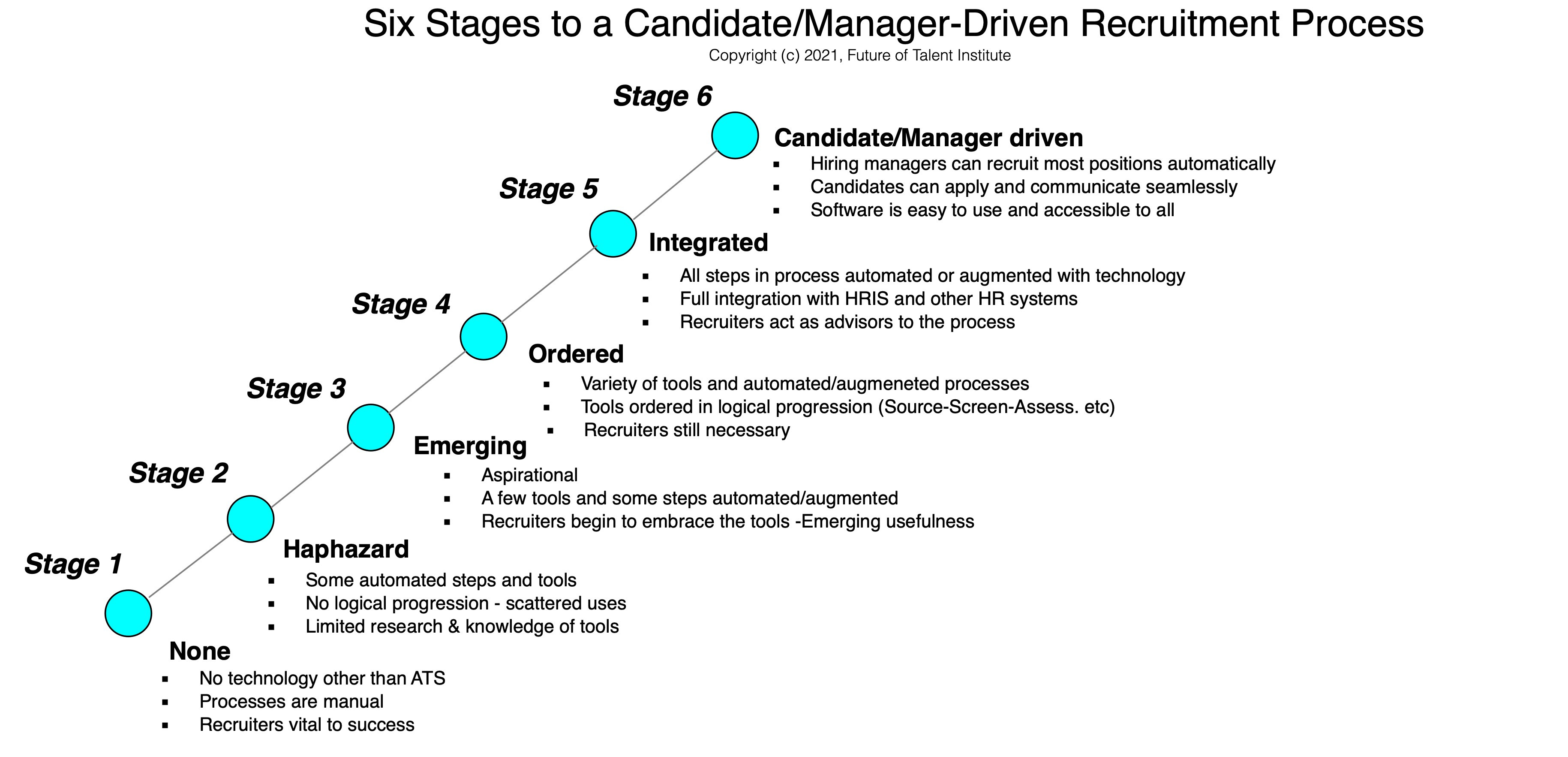
If you are at Stages 1-3, you have some work to do, and you need to do it quickly to remain competitive. If you are at Stages 4-5, you’ve made tremendous progress but have one major step to go: getting to the candidate/manager-driven level where your services are only minimally needed, if at all. Next week I will expand on each of these stages.
Just adding a few tools to your current processes or tweaking what you are doing is not progress; it’s a desperate attempt to stay current while falling behind. It’s making a better horse rather than envisioning what the automobile can offer.
I end with this quote from T.S. Eliot.
“Nothing pleases people more than to go on thinking what they have always thought, and at the same time imagine that they are thinking something new and daring: it combines the advantage of security and the delight of adventure.”
Moving to Stage Six is hard, but the payoff will be immense.
This article originally appeared in the Future of Talent newsletter and has been republished here with permission.
Cover image: Shutterstock