A few years back, a hiring manager came to me with a clear ask. “Jo is leaving in eight weeks. We need another Jo.”
I did the work. Found three Jo’s. Strong candidates, near-identical backgrounds, the lot. The manager interviewed all three, came back unconvinced about each one, and asked us to keep searching. Six months later the role was still open, the team was stretched thin, and the manager was frustrated with TA.
The real problem had nothing to do with sourcing. Jo had been hired three years earlier when the business was solving a different problem. The business had moved on. Jo hadn’t been replaced because Jo-as-defined no longer existed in the market, and even if she had, she wasn’t what the team actually needed next. Nobody had asked the question at intake.
This is what reactive hiring looks like. And it’s where most sourcing strategies, however well-built, quietly fall apart.
The hiring manager is where strategic sourcing succeeds or fails
TA has spent the last few years getting more strategic. Talent mapping, market engagement, pipeline building, structured outreach. All of it useful, all of it necessary. But none of it works if the hiring manager is still operating in replacement mode, treating every vacancy as a like-for-like backfill and every brief as a search for the last person who held the role.
The gap between how modern TA wants to work and how most managers brief roles is where strategic sourcing goes to die. Coaching the hiring manager isn’t a side activity. It’s the work.
Three things worth coaching them through.
- Clone hiring
The “we need another Jo” reflex is everywhere. It feels safe to the manager because they know what they’re getting, or think they do. The problem is the business is rarely the same business it was when the last person was hired. Skills the team will need in 12-18 months are often not the skills the outgoing person brought.
The coaching move is to shift the conversation away from who the last person was and toward what the role needs to deliver next. The best TA leaders I know run forward-looking intake conversations that take 30 minutes and force the manager to articulate three things: what does success look like in the next year, what skills does that actually require, and what’s changed since the last hire was made. If the answer to the third question is “nothing has changed,” that’s a useful conversation in itself.
Two questions move the manager out of replacement mode. Try them in the intake call:
“If we hire someone who does exactly what Jo did for the next two years, where does that leave the team exposed, given what is coming?”
“What is the number one problem this hire needs to solve in their first 90 days that Jo was not already working on?”
- Impatience
Strategic sourcing takes time because it’s building pipeline, not flipping CVs into an inbox. Managers under pressure want speed, and speed is the enemy of quality when the brief is wrong.
The coaching move here is to make the trade-off visible before the search starts. Agree timelines at intake, agree what “good” looks like, and revisit both when the manager starts pushing for shortcuts at week four. If the manager wants to compromise, fine, but make them choose what they’re compromising on. A fast hire against the wrong brief costs more than a slower hire against the right one.
- Misaligned expectations
Senior capability at mid-level pay. Ten must-haves for a role that genuinely needs four. A unicorn that doesn’t exist in the local market. Every TA leader has seen this brief.
The coaching move is to bring market reality into the room. Salary benchmarks, candidate availability data, comparable role timelines. Not to argue with the manager, but to ground the conversation in something other than hope. The conversation that needs to happen is rarely “we can’t find this person.” It’s “this person doesn’t exist at this price, in this market, in this timeframe. Which of those three are you willing to move on?”
The same trap shows up when a manager hands you a ten-point unicorn brief. Do not say “this is unrealistic.” Bring the real numbers for that role and lay out the trade. It sounds like this:
“Based on the data for this role, candidates with all ten of these skills are less than 2% of the active market, and the ones who exist are commanding around 30% above our budget. If we split this into four must-haves for day one and six nice-to-haves we can develop, we open up roughly 60% of the market. Which four are non-negotiable for day one?”
A quick way to triage the brief
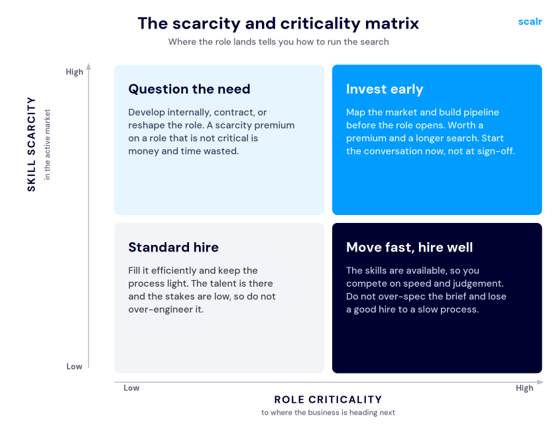
One simple tool helps the manager see the trade-off at a glance. Plot the role on two axes: how critical it is to where the business is heading, and how scarce the skillset is in the market. Where it lands tells you how to run the search, and which of the three conversations above you need to have.
What good looks like
The TA teams I’ve seen do this well treat hiring manager coaching as core work, not an awkward conversation tacked onto an intake call. They invest in the relationship before the requisition lands. They challenge briefs that look like the last person’s job description. They bring data, not opinions. And they’re willing to push back, calmly and consistently, when a manager wants to hire reactively.
This isn’t about TA being right and hiring managers being wrong. Managers brief reactively because hiring is uncomfortable and replacement thinking feels safe. TA’s job is to make strategic thinking feel safer.
The shift from reactive to strategic sourcing isn’t really a sourcing shift. It’s a hiring manager shift. Get that right and the rest follows.