It’s no secret that recruiters want access to more data to try and drive a more positive hiring experience for everyone involved.
Our recent State of Talent Acquisition survey discovered that better access to metrics and data is at the top of the wish list for most talent teams, with 43% of all respondents identifying it as the top capability they wished they could access in 2023.
When it comes to improving performance, we know we need to measure certain elements of the hiring process; time to hire, cost to hire, quality of hire, turnover, diversity markers, candidate experience, recruiter experience, hiring manager experience…the list goes on. And on. And on.
But according to Kevin Wheeler, talent teams rarely question the metrics they use – rather, they just assume that they are valid.
“We report [the metrics] because everyone else does, and rarely does anyone question them or challenge the assumptions they are based on. The recruiting metrics we generally use do not give a useful picture of the effectiveness or strategic capability of the talent acquisition function.”
Which begs the question – which recruiting metrics should we be focusing on to make a difference in our talent strategies and how we deliver great talent to drive organisational growth?
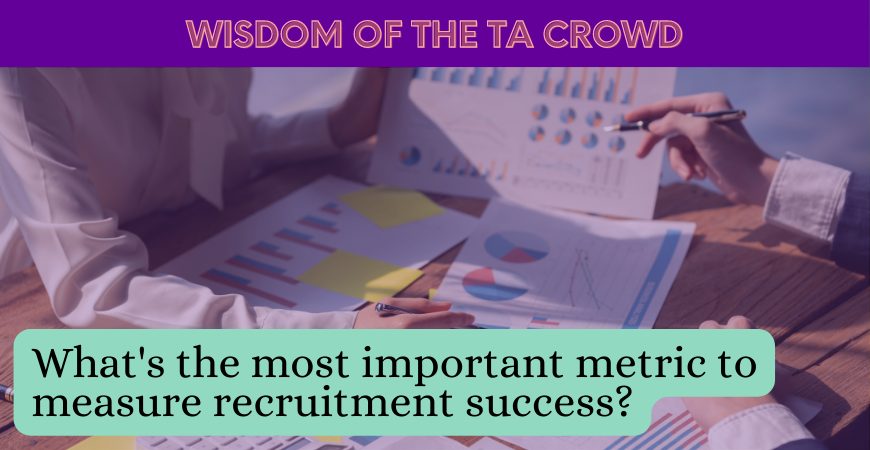
With that in mind, we put the question to our talent community; If they could only focus on one metric in their role, which one would it be? Here’s what they said.
Retention and engagement
 Simon Hedt, Senior Manager, Talent Acquisition @ Slalom Build
I honestly don’t think I could drill down to just 1 key metric as I am a firm believer in driving quantity and quality however, if forced, I would go with measuring quality. Specifically, I think this would be a retention & employee engagement statistic, expectations set equals expectations met, and we in TA are pivotal in setting expectations for new employees. High levels of retention and engagement says to me that not only are we hiring the right people, but we’re setting them up for success as well. If we hire all the right people but misrepresent the business and the role, they will probably leave within the first 12 months and all that effort would be for naught.
 Aligning metrics to business KPIs
Alisha Hook, Talent Acquisition Lead @ CareSuper
In an evolving workplace this is a difficult one to answer. Personally, I think it’s important to be adaptable and success comes from really understanding the organisation’s strategic goals, your manager’s KPI’s and how your role fits into that and at the same time needs of my stakeholders/ hiring managers. Ultimately doing this effectively should result in high quality hires.
 Quality of hire
Kunal Gokuldas, Head of Talent Acquisition @ Civica
Key metric for us is quality of hire. There is a lot of focus on time to hire, but how well fit the candidate and the company are to each other is far more important than how quickly a role is filled. This is measured through employee surveys at 3 months of joining the company; performance rating at end of probationary period and at 12 months, attrition under 6 months etc. Key to recruitment has to be measured by how well a candidate and company are best suited for each other.
 Focus on the metrics that align your people strategy to your business strategy
Pavi Iyer, Head of People & Talent, Mindset Health
I think the most important metrics (there’s more than one that’s required to be able to tell a story), for People roles would be retention rates, employee engagement/NPS & performance management metrics. These combined give you an insight into your culture, working environment, employee wellbeing, recruitment success and attraction strategies. The more defined these metrics are, the easier it will be to analyse your areas of improvement, identify gaps and be able to act on them accordingly.
Measuring the alignment of your People strategy with overall business strategy can help ensure that initiatives are supporting the organisation’s goals and objectives. Ultimately, the most important metric to focus on will depend on the organisation’s goals, priorities, and challenges. A comprehensive approach that considers multiple metrics can help ensure a well-rounded view of success in a Head of People role.
 Stakeholder feedback
Steve Scannell, Senior Resourcing Adviser @ New Zealand Ministry of Foreign Affairs & Trade
Stakeholder feedback, this can be hard to get and measure but in my role if I am adding valuable insights to their recruitment process and ultimately filling roles then the other metrics don’t matter as much.