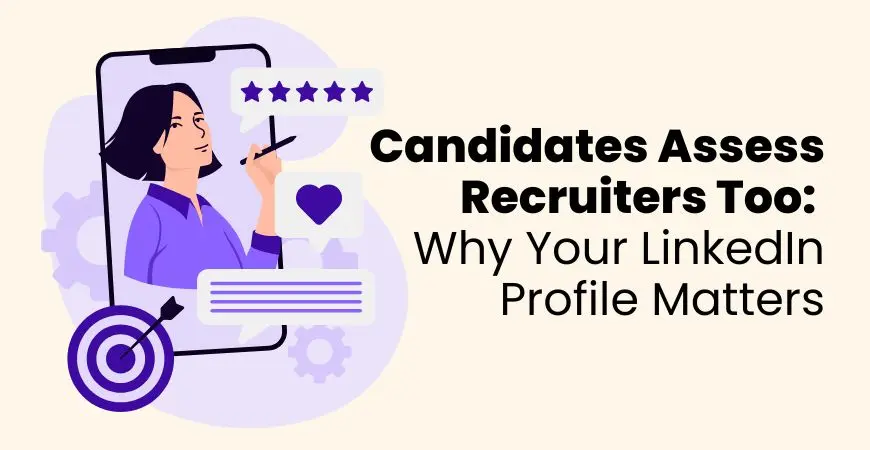
Recruiters assess candidates every day. We review CVs, LinkedIn profiles, communication style, credibility, attention to detail, career progression and professional judgement. But candidates are assessing recruiters in exactly the same way.
If you are reaching out to passive candidates, approaching senior leaders, representing an organisation or asking someone to trust you with a career conversation, your own professional presence matters. Whether we like it or not, LinkedIn is usually where people do a quick credibility check.
They see your message. They click through. They scan your profile. In a few seconds, they are forming a view.
Candidates are often subconsciously asking questions like:
- Credibility & Professional Capability
- Are you credible?
- Do you look experienced enough to guide a meaningful career conversation?
- Do you seem commercially intelligent and informed?
- Do you have influence inside the organisation, or are you just a process gatekeeper?
- Trust, Advocacy & Representation
- Would I trust you with sensitive career information?
- Are you someone I’d want representing me internally?
- Would you advocate for me properly?
- Human Experience & Relationship Quality
- What are you like to work with or engage with?
- Will I be treated like a transaction or a human?
If you’re looking at your LinkedIn profile as online CV, you’re missing the most crucial elements. Reputation management, trust indicator and marketing toolkit.
Whether you like it not, your profile is part of the trust equation, and it should quickly and easily answer one question.
Are you someone worth responding to?
Or does this feel like another cold message fired into the void with all the warmth of a parking fine? This is not about becoming a LinkedIn influencer. Please, we have enough ring lights in the world. It is about trust and credibility.
Trust does a lot of heavy lifting in hiring. Especially in leaner markets. Especially when there are so many fake profiles and scam outreach happening.
Candidates are sharing personal career information, motivations, frustrations, ambitions, compensation details and often vulnerability. Your professional presence either strengthens confidence or weakens it.
A good message helps, but the message is only one piece of the puzzle. Your profile needs to back it up.
So if someone receives a thoughtful message from you, then clicks through to a profile to find a half-complete profile, vague headline, outdated experience section or limited visible evidence of industry engagement, I think you know you what’s likely to happen next.
Hello black hole.
Not because you are not credible, but because you have not made that credibility visible.
Your LinkedIn Profile Is More Than Just Trust Signalling
The benefits of maintaining a strong and current LinkedIn profile extend well beyond candidate perception.
Professional Benefits
A strong LinkedIn presence can:
- Improve candidate response rates
- Build recruiter credibility before outreach
- Increase inbound opportunities from employers
- Strengthen professional and industry reputation
- Make expertise visible to leadership
- Support speaking, advisory, and networking opportunities
- Help peers understand your specialisation
- Demonstrate commercial and strategic capability
- Improve discoverability in recruiter and employer searches
- Position you for future leadership opportunities
- Provide evidence of outcomes and achievements
- Create a public portfolio of your work and thinking
- Reinforce employer brand credibility
For many Talent professionals, LinkedIn has become part portfolio, part reputation layer, part industry signal, and part opportunity engine.
Personal Benefits
There are also personal gains that are often overlooked.
Keeping your profile current can:
- Build confidence in your own professional narrative
- Help articulate career progression and strengths
- Encourage reflection on impact and growth
- Make career transitions easier
- Reduce panic-updating during redundancy or restructure
- Help maintain professional relationships over time
- Create career resilience in uncertain markets
- Give you ownership over how your story is told
That final point matters more than many people realise.
If you do not actively shape your professional narrative, the market often fills in the blanks for you.
TA professionals need to take their own advice
Here is the awkward bit. Talent professionals are often excellent at helping other people position themselves, but far less disciplined when it comes to their own career brand.
We know when a CV is too task-heavy. We can spot a vague LinkedIn headline from 40 paces. We coach candidates to talk about impact, not just responsibilities. We tell people to be clear, current and specific.
Then we turn around and describe ourselves as “experienced end to end recruiters” and hope for the best.
Modern Talent Acquisition is much broader than filling roles. Strong TA professionals influence employer brand, candidate experience, hiring manager capability, sourcing strategy, internal mobility, AI adoption, process improvement and commercial decision-making.
That is real business impact, but too often the way TA professionals describe themselves does not reflect the value they create.
This matters even more in the current market. Roles are changing, teams are leaner, expectations are higher and the bar for standing out is no longer “I have managed recruitment end to end”. That may get you understood, but it will not necessarily get you noticed.
Talent professionals need to articulate the problems they solve, the outcomes they deliver and the way they think. That is what helps you move from being seen as someone who fills jobs to someone who improves hiring.
Personal brand is practical, not performative
Personal brand has been made to sound far more embarrassing than it needs to be.
It is not about posting daily thought leadership, manufacturing a hot take, announcing you are “humbled and honoured” every second Thursday, or adding “future of work” to everything until everyone quietly closes the tab.
For Talent professionals, personal brand is much simpler and much more useful. It is the evidence trail that helps people understand who you are, what you know, how you think and why they should trust you.
A strong personal brand does not need to be loud. It needs to be clear.
Personal brand is not performance. It is professional evidence.
If you spend your days helping other people tell better career stories, it might be time to give your own the same level of care.
For Talent professionals wanting practical support, BrandYOU helps sharpen your CV, LinkedIn profile, career positioning and use of AI, so you can show up clearly and confidently in market without sounding like you have been assembled from a corporate template.
Upcoming Events: https://events.humanitix.com/host/kindtide