Twenty years ago, when Trevor Vas, Horace Chai and I began what became the Australasian Talent Conference, recruiting was a very different profession. LinkedIn was barely established, smartphones had yet to transform how we communicated, social recruiting did not exist in any meaningful form, and artificial intelligence was largely an academic subject.
Yet when I look back through the agendas of ATC, what strikes me is not simply how much has changed. It is how persistent some of the fundamental questions have been.
The first ATC was held in 2007. Its agenda now reads almost like an archaeological record of modern Talent Acquisition. We were talking about candidate experience, talent pipelines, recruiting metrics, proactive sourcing, internal talent, technology and the ageing workforce. Gerry Crispin asked whether candidate interactions would “engage them, inform them or confuse them and turn them elsewhere.” Trevor and I ran a workshop on talent pipelines, pools and networks. Westpac described moving from a preferred-supplier model toward centralized internal recruitment.
The technology was primitive by today’s standards, but the ambition was not. One session noted that only about half of Australia’s top 100 organisations were then using sophisticated technology to support Talent Acquisition. Another discussed building pre-qualified pools of passive candidates rather than waiting for a vacancy and advertising it. The underlying idea was already there: recruiting needed to become proactive rather than reactive.
From recruitment to talent
By 2011, that idea had become the conference theme: “Moving Recruitment into the Talent Management Zone.” The cover promised “New tools. New assumptions. New thinking.” In our welcome, Trevor and I wrote that recruiters needed to “foresee and adapt to change.”
And change was arriving rapidly.
The agenda included mobile recruiting, LinkedIn and social recruiting, talent communities, passive talent, diversity, internal mobility and employer value propositions. Accenture described using LinkedIn and social networks to change recruiting; other sessions explored the ROI of social media and how social tools could create continuously updated relationships with candidates.
It is easy to forget how radical this seemed. Just a few months before this conference people were saying that social media would never be important to recruiting in Australia. It invaded privacy and was likely illegal. I see parallels to this in today’s arguments about the impact of AI.
Recruiting was beginning to escape from the ATS and the job advertisement. Candidates were becoming visible before they applied. Relationships could be maintained over time. Employer reputation was becoming transparent. The recruiter’s job was already starting to change from processing applicants to finding, engaging and influencing people.
Then came disruption
The 2016 conference was explicitly framed around “Talent Acquisition Strategies for a VUCA World.” Disruption was no longer something on the horizon. It was the environment in which organisations operated.
Australia Post described transforming a 200-year-old organisation for the digital era. Bupa discussed moving from Talent Acquisition to Talent Experience using design thinking. Other sessions examined video interviewing, predictive analytics, digital candidate experiences and emerging HR technology.
And an interesting challenge appeared that remains with us today. One session imagined “Automation Utopia” or end-to-end automation of Talent Acquisition but immediately argued that the objective should not be eliminating humans. Technology should perform the administrative work so human time could be invested where it mattered. A year later we made that the theme “Recruitment Rewired: Automation | The Humane Recruiter | Talent Economy.” These themes resonant even louder today.
The agenda combined automation, predictive analytics and digitally enabled screening with employer brand, candidate preferences, inclusive language and human connection. I presented a workshop on predictive analytics. Another session challenged time-to-fill and cost-per-hire as meaningful measures of recruiting performance. Technology was getting better. But the central question was becoming: What should technology do, and what should humans do? Twenty years later, we are still answering it.
From recruiting people to orchestrating work
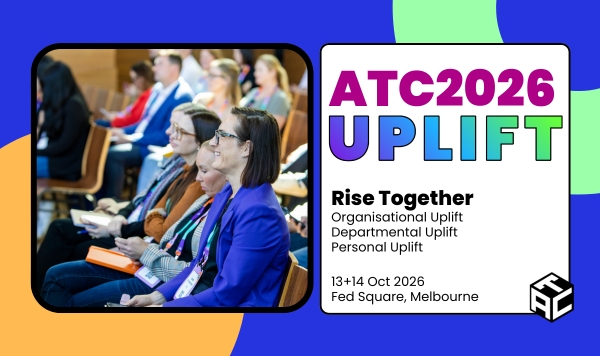
The 2026 agenda, UPLIFT, marks perhaps the biggest shift yet. For most of ATC’s history, we assumed the fundamental unit of recruiting was a job, and the fundamental objective was to find a person to fill it. That assumption is now breaking down.
Movember’s Workforce Lab asks a very different question before a requisition even exists: What work needs to be done? Can it be absorbed, redesigned or shared? Does the capability already exist internally? Should we buy, build, borrow or bot?
AI agents are now being deployed inside real talent teams. Another session asks what work should remain human when AI performs sourcing, screening and early matching. And my own 2026 session looks toward an agentic TA world in which autonomous systems increasingly perform sourcing, screening, engagement and workflow while recruiters concentrate on judgment, influence, relationships and closing. The recruiter becomes an orchestrator. That is an long distance to travel in twenty years: from building candidate databases to deciding how work should be divided among employees, contractors and machines.
And yet, some things haven’t changed
Perhaps the most revealing thing about reading twenty years of ATC agendas is that technology keeps changing while the human problems stubbornly remain.
Candidate experience appeared in 2007. It is still on the 2026 agenda—now based on an experiment applying to jobs at Australia’s 100 largest companies and finding broken applications, contradictory communications and duplicate rejections.
We talked about talent pools in 2007 and talent communities in 2011. Today we call the larger idea workforce orchestration. We talked about metrics in 2007, predictive analytics in 2017, and in 2026 we are asking Talent leaders to connect workforce decisions to revenue, productivity, risk and EBITDA. The vocabulary changes. The ambition keeps moving upward.
The next ATC
That may also tell us what ATC itself must become. The conference began by helping recruiters become better recruiters. It evolved into helping Talent Acquisition leaders understand technology, candidates, data and business transformation. The next phase must go further.
As AI absorbs more transactional recruiting work, the profession will probably become smaller, but the work that remains will be more consequential. The future Talent leader will need to understand business strategy, organisational design, workforce economics, technology, skills and human capability and not simply recruiting.
ATC should increasingly be a place not simply to hear presentations, but to test ideas, challenge assumptions, examine experiments and learn from what failed as well as what worked. In an age when AI can deliver information instantly, the value of gathering physically is no longer access to information. It is access to people, experience, debate, judgment and community.
There will still be a need for a place where people trying to understand what comes next can meet, disagree, experiment and learn from one another. That was the reason for creating ATC twenty years ago. It may be an even better reason for continuing it for the next twenty.