Across large organisations, one of the most persistent debates in workforce strategy is: Who owns the Contingent Workforce?
This control struggle, generally between Talent and Procurement, holds organisations back.
Begin with a few simple tasks:
- Reframe your thinking from Ownership to Enablement. You’ll begin to see conversations broader.
- Map the interests and concerns of Talent and Procurement leaders on a Venn diagram and you’ll see that they rarely overlap.
Six of the core principals of good Contingent Workforce Management include: Visibility, Risk and Compliance, Supplier and Cost Management, Supply and Delivery, Employee Experience, Challenges and Opportunities such as Competitive Advantage. Using enablement as your guiding principal, ask these questions:
- How can we enable Visibility of the Contingent Workers
- How do we enable the Organisation to manage Risk and Compliance
- How do we enable Business Leaders safe access to Suppliers and sound Cost Management
- How do we enable the Supply and Delivery of top Contingent talent
- How do we enable “Employee” Experience for Contingent Workers
- How do we enable the business to find and solve Challenges
- How do we enable Opportunities the business to use their Variable Workforce to win in market
Take the 15-minute survey and diagnostic on these six elements: Take Survey
Talent leaders focus on visibility, capability, speed, and workforce outcomes. Procurement leaders prioritise cost control, risk, and supplier performance. Business units want flexibility and fast access to skills. When one stakeholder wrestles control of their Contingent Workforce, dangerous trade-offs are made. Many remain in a state of constantly addressing foundational issues such as visibility and compliance, without progressing to optimisation, AI enablement, or using contingent talent as a competitive advantage in market.
Where Ownership Sits Today
ATC’s recent Contingent Workforce Survey revealed that leadership structure strongly correlates to maturity of the program. Programs jointly led by Talent Acquisition and Procurement achieve the highest maturity ratings. Programs run solely by business units record the lowest. Despite this, many organisations still place responsibility for contingent labour within the broader business units. The survey results show current ownership as follows:
- Business unit directly: 35%
- TA and Procurement jointly: 27%
- Talent Acquisition: 22%
- HR: 9%
- Procurement and HR: 6%
- Other: 1%
When contingent workforce management is left entirely to the business, you see decentralised decision-making, inconsistent controls, and very limited enterprise-wide visibility. That doesn’t mean the business shouldn’t be involved. It means the operating model hasn’t been designed with governance in mind.
It’s not surprising that 61.8 per cent of the organisations that completed the diagnostic/survey, rated their contingent workforce maturity as low.
We spoke to three leading organisations about how their Contingent Workforce Model operates.
OPTUS, Ken MacLeod, Associate Director – Talent Acquisition
Who leads Contingent at Optus: Shared Effort
Effective management of contingent workers, requires joint ownership and collaboration between several business units:
- Procurement manages supplier and contract governance
- P&C manage compliance of the individual workers
- IT manage systems and equipment provisioning and access
At Optus, engaging contingent workers gives us the ability to be nimble and flex our workforce as needed. But as an organisation operating in in a highly regulated environment, risk management, governance, and compliance are always front of mind.
Our centralised VMS, managed by our Contractor Central team ensures we have visibility and oversight of our entire contingent workforce which, minimises risk while enabling hiring managers to engage contingent workers without an excessive administrative burden.
CANVA, Mike Gauci, Contingent Workforce Program Leader
Who leads Contingent at Canva: Talent Acquisition
Having led contingent workforce programs across Talent Acquisition, HR/Operations, and Procurement/Finance, I’ve partnered with many talented people who bring unique and valuable perspectives. I’ve worked with procurement leaders who challenge stereotypes by leaning deeply into experience and candidate outcomes, just as I’ve seen TA leaders develop strong fluency in cost-saving data and ROI metrics.
What I firmly believe, however, is that where the contingent workforce sits from an organisational perspective is less important than how it is owned. What matters most is that the function accountable for the workforce drives a genuinely collaborative approach with leaders across key disciplines – ensuring these diverse viewpoints are embedded into program metrics, decision-making, and goals.
At Canva, we place a strong emphasis on delivering exceptional hiring experiences. Having the contingent workforce sit within Talent Acquisition allows us to fully leverage the expertise of our talent partners and their leadership. As our approach to identifying and engaging top talent continues to evolve, the contingent hiring team benefits directly from these advancements. This structure also enables us to share talent seamlessly across permanent, fixed-term, and contingent roles, and to partner closely on opportunities such as contractor conversions where appropriate.
This close alignment is supported by dedicated operations and business partners who provide tailored guidance and experiences for contingent workers and their leads (key contacts), ensuring consistency, clarity, and care throughout the engagement.
Equally important is what I would describe as a beautiful relationship with our Procurement, Finance/Accounts, IT/Security, and People Partnering (HR) teams – along with many others. Because the contingent worker lifecycle spans multiple functions, our team acts as a central sponsor, coordinating across these lanes to drive strong outcomes and respond effectively to more complex or “out-of-the-box” scenarios.
While curveballs are inevitable in the world of contingent workforce management (and part of why I love this space), having access to a broad range of expertise allows us to take a truly multi-dimensional view – balancing quality, speed, cost, and compliance to achieve the best possible outcomes.
MEDIBANK, Carrie Harding, Head of Governance, Culture & Accountability Uplift
Who leads Contingent at Medibank: Shared Effort
- Recruitment managed by Talent Function, now led by Kelly O’Connor
- Engagement and Payroll managed by an MSP
- Consulting managed by Procurement
When I first came into the Contingent role, I had two choices. I could take the well-trodden path of the lone wolf, letting siloed thinking continue while convincing myself (and hopefully my boss) that I was making progress. Or I could bring people together and find a way to work collaboratively. I knew teamwork would lead to a better outcome, but I also knew I might run into challenges – departmental turf wars, capability gaps, misaligned priorities, or an inability to commit to a shared goal. We came together – Talent, Procurement, Employee Relations. With three passionate people who knew their stuff and cared deeply about the work, we achieved far more than I ever could have alone. Alignment is critical to managing a successful contingent workforce. Talent focuses on speed and delivery, candidate experience, and securing the right skills. Procurement is driven by cost control, risk mitigation, and contract compliance. Employee Relations ensures adherence to labour laws, fair treatment, and risk management. Each function has its own priorities, but without collaboration, you risk inefficiencies, compliance issues, and missed opportunities. When these three teams work together, they can create a balanced strategy that supports both business agility and governance. Did we have some tough conversations? Yes. Did we face any of the tricky challenges I had worried about? A few. But did we get there? Absolutely.
If this conversation resonates, the next step is to pressure test your own model against peers.
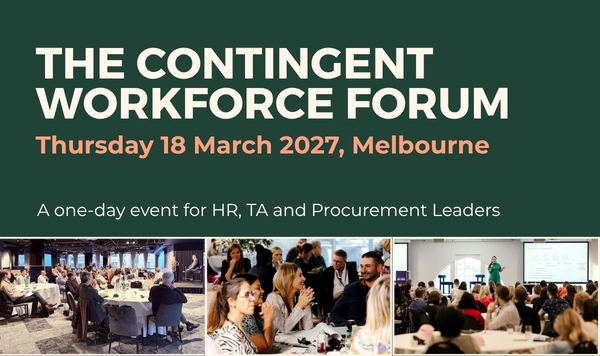
We are hosting the Contingent Workforce Forum which brings together Talent, HR, Procurement, and Workforce leaders to move beyond reactive contractor use and into deliberate workforce design. This is a forum for organisations ready to treat contingent capability as a strategic lever, rather than an operational afterthought, and to build workforce models that can flex without breaking.
Checkout Event: https://shorturl.at/5GzSm
📅 13 March 2026 | 📍Amora Jamison, Sydney