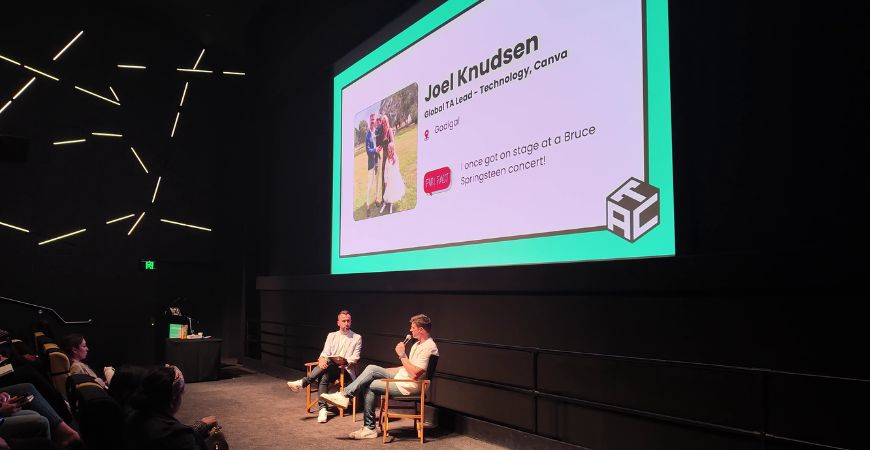
A Re-cap of the session that Joel Knudsen, Global TA Lead for Engineering at Canva presented at ATC2025.
Realising they had a problem
Canva’s interview process for Front End & Back End Engineers asked candidates to solve coding problems without the very tools they’d use on the job. This interview format pre-dated the rise of AI tools and the change in the way that Canva now operated.
Why Canva redesigned their Technical Interviews
All Front End and Back End Engineers at Canva now use AI tools daily. They leverage AI to prototype ideas, understand their large codebase, and generate code. This new way of working meant that job interviews didn’t mirror the new engineering workflows. The old model was syntax recall and algorithm drills but, the new and now ‘real’ work was prompting, code review and trade-offs. We needed better signal on engineering judgment so we evolved our hiring practices to match the new tools and practices being used. The other reason is that some candidates were already using AI covertly in the hiring process. Detection is impractical and undermines fairness. They chose to embrace transparency and work with the new reality rather than try to police it.
Canva says “This isn’t about letting AI do all the work. We’re evaluating candidates on skills that matter more than ever:
- Do they understand when and how to leverage AI effectively?
- How well do they break down complex, ambiguous requirements?
- Can they make sound technical decisions while using AI as a productivity multiplier?
- Can they identify and fix issues in AI-generated code?
- Can they ensure AI-generated solutions meet production standards?”
How we build the new process
They determined that the new requirement was: Assesses effective collaboration with AI tools to solve problems. Evaluate the rigor, critical thinking, and solution robustness.
This meant less ‘raw recall’ skills and more focus on prompting quality, critical review, and decisions.
Tool Agnostic: Come with the tool you are most comfortable with; Copilot, Cursor, Claude, etc.
Structured by Level: They structured the assessment by role type and level
- Engineer: Drives solution, iterates cautiously, reviews AI code.
- Senior Engineer+: Proactive scoping, architectural depth, advanced AI usage.
- All levels: Clear explanations of trade-offs & testing strategy.
Problems can’t be solved with a single prompt; they require iterative thinking, requirement clarification, and good decision-making.
The Roll Out
Canva ran a small pilot program to measure outcomes and create a feedback loop to augment before a broader roll out. The process was simple: Pilot → feedback consolidation → full rollout to all Back End/Front End roles.
They recorded mock interviews for practice and ran a shadow interview program to build confidence in their interviewers. They developed assessment frameworks and example follow up questions to probe AI usage & judgment. Interviewer involvement and guidance was encouraged to make it feel more conversational. Transparent candidate communications were created and candidates were told upfront they are expected to use AI in the hiring process. As Canva is looking for AI-first thinkers, this also spells to the candidate market what kind of engineers will succeed at Canva, a smart move when it comes to candidate attraction.
The Results
Critical skills assessed: People who performed well proved to be good problem solvers, adaptable and curious. Critical traits for the future of work
AI attitude: Attitude toward AI is itself a hiring signal. Candidates that showed keen interest in AI during the recruiter screen performed well.
Interview quality: Richer discussions on trade-offs, edge cases, and solution quality. It also allowed exploration of more complex, realistic product problems.
Internal alignment: Initial scepticism eased once rigor expectations were clarified.
What they learned from the Pilot
- AI enables faster iteration → time for deeper problem-solving.
- Candidates need strong prompting skills + critical review ability.
- Interviewers now play a more active role in probing judgment and technical depth.
- The interview favours candidates that are curious and set up to ride the wave of technological advancement.
Whilst this session was about FE and BE Developers, I can see how this could translate to the way in which many professionals do their job. This process could equally apply to a Marketer, Product Manager, Researcher, Recruiter, Analyst – almost any professional in 2025 and beyond.
If you want to learn more, checkout Canva’s blog.
Here’s what other attendees in the room had to say:
Sanghita Mukherjee
Talent Acquisition Business Partner, People & Culture, NCSI Australia
“It made me think about how AI is not replacing developers but augmenting their capabilities. The future of coding is collaborative – developers will partner with AI to generate clean, efficient code while maintaining accountability. AI-driven interviews enable the assessment of critical skills while ensuring a structured, high-quality process that aligns internally across stakeholders. The concept of assessing a candidate’s ability to work with AI tools feels forward-thinking and practical. Questions I Have Walked Away With:
- How do we standardize the evaluation of prompting skills across different roles and levels?
- What safeguards should be in place to ensure fairness when candidates use AI tools during interviews?
- How do we balance AI assistance with assessing a candidate’s core problem-solving ability?
- What training or enablement do hiring managers need to effectively evaluate AI-driven coding approaches?
Stefan Welack
Global TA Enablement & Employee Experience Lead, Xplor Technologies
“It’s a subtle but important shift – away from testing what someone knows, and towards understanding how they think. And to be fair, I got a lot of my inspiration from Canva’s work in that space. It’s one of the main reasons we have guidelines and a candidate AI policy in place. This is smart, because in the next few years, every job will involve some form of human-plus-machine collaboration. And the people who thrive won’t be the ones who simply memorise processes but ones who stay curious.”
A message from ATC Team:
ATC2025 gave us so many moments worth remembering – insightful sessions, honest conversations, and that buzz of the Talent community coming together.
As we look ahead, planning for ATC2026 starts now.
Download the new ATC2026 Budget Planner to help make the case, secure funding, and bring your team along next year.
13–14 October 2026 | Fed Square, Melbourne